Advances in Polymer Membrane Technology for Water Purification
Introduction
Water scarcity and contamination remain among the most pressing challenges of the twenty-first century. As global demand for clean water intensifies, the scientific community has directed considerable resources toward improving the efficiency, selectivity, and longevity of polymer-based membrane systems. The International Congress on Membranes and Membrane Processes, held in San Francisco in 2017 and convened under the banner of ICOM 2017, brought together leading researchers and engineers to examine the state of the art in membrane-driven water treatment. The insights exchanged at that congress continue to shape laboratory and industrial practice.
Fundamentals of Polymer Membrane Separation
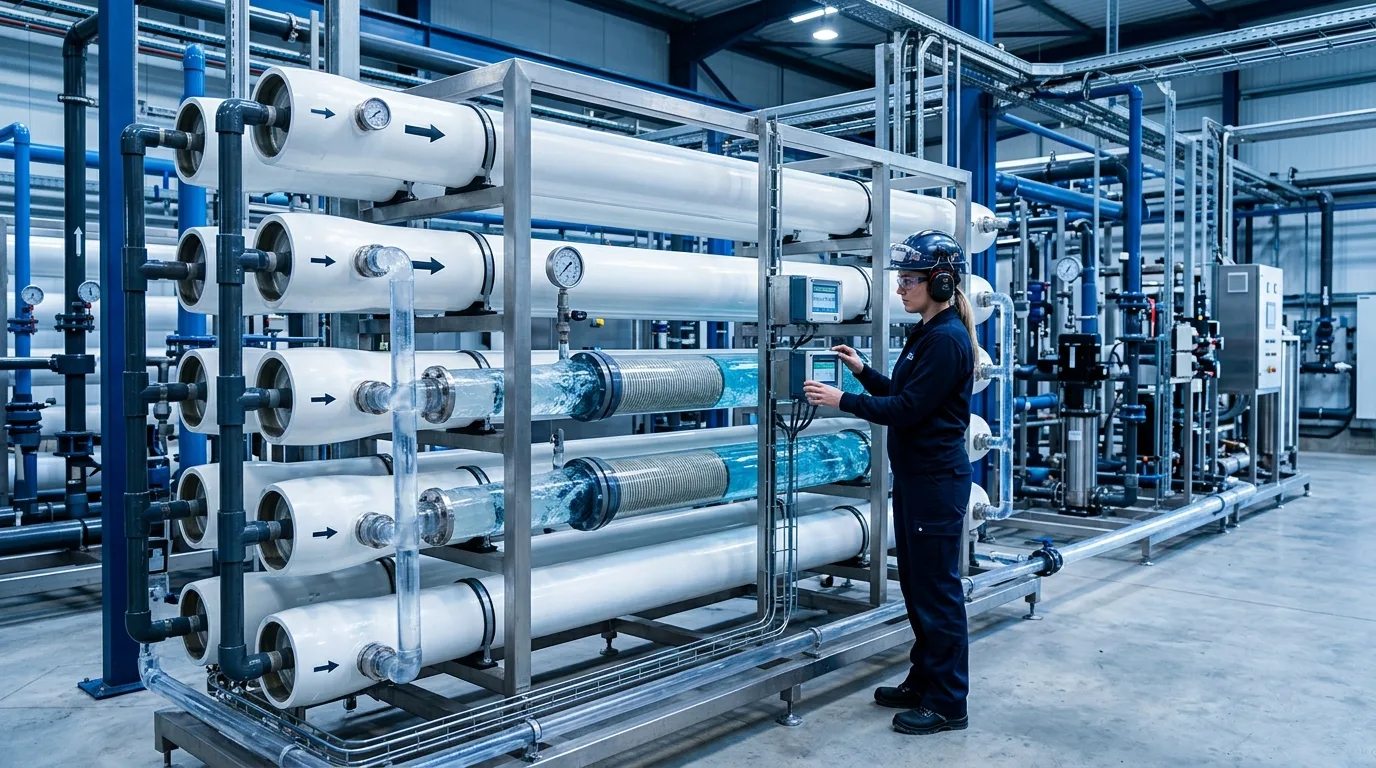
Polymer membranes function by exploiting differences in the size, charge, or chemical affinity of dissolved or suspended species. The principal configurations deployed in water treatment include microfiltration (MF), ultrafiltration (UF), nanofiltration (NF), and reverse osmosis (RO). Each operates across a distinct pore-size regime, from the relatively open channels of MF membranes, typically 0.1 to 10 micrometres, to the effectively nonporous barrier of RO films, which reject ionic solutes through solution-diffusion mechanisms.
Polyamide thin-film composite (TFC) membranes represent the dominant chemistry in high-pressure applications such as seawater desalination. The selective layer, formed by interfacial polymerisation of an aromatic diamine with a triacyl chloride, achieves salt rejections exceeding 99 percent while maintaining commercially acceptable water permeance. Continued refinement of monomer chemistry, crosslink density, and surface modification protocols has progressively relaxed the permeability-selectivity trade-off that characterised earlier generations.
Surface Engineering and Fouling Mitigation
Fouling, the deposition of organic matter, colloidal particles, and microorganisms on membrane surfaces, remains the principal barrier to stable long-term performance. Research presented across the ICOM 2017 congress programme highlighted several converging strategies for fouling control. Hydrophilic surface coatings, including polyethylene glycol (PEG) grafts and zwitterionic polymer brushes, reduce the thermodynamic driving force for foulant adhesion. Nanocomposite approaches incorporating titanium dioxide or graphene oxide fillers within casting solutions have demonstrated measurable improvements in both hydrophilicity and photocatalytic self-cleaning capacity under ultraviolet irradiation.
Structural modification at the membrane substrate level, particularly the transition from conventional asymmetric sponge structures to hollow-fibre and thin-film nanocomposite architectures, alters boundary-layer dynamics and reduces concentration polarisation. Numerical modelling tools that couple computational fluid dynamics with mass-transfer correlations now permit rational module design aimed at reducing foulant accumulation zones prior to fabrication.
Hollow-Fibre Configurations in Municipal Applications
Hollow-fibre ultrafiltration systems have achieved widespread deployment in municipal drinking water treatment due to their high packing density and suitability for dead-end or semi-dead-end operation. A single module can accommodate surface areas exceeding 50 square metres per cubic metre of module volume, substantially reducing the footprint compared to spiral-wound elements operated at equivalent flux. Fibre morphology, including inner and outer diameter, wall thickness, and the macro-void distribution within the cross-section, determines both the hydraulic resistance and the mechanical resilience to pressure cycling during backwash sequences.
Research groups affiliated with ICOM 2017 demonstrated that dual-layer hollow-fibre co-extrusion, combining a tight selective outer skin with a porous mechanically robust inner substrate, yields membranes capable of sustaining 107 pressure cycles without delamination. These results have direct implications for plant operators seeking to extend membrane lifetime and reduce capital replacement costs.
Emerging Polymer Chemistries
Beyond the well-established polyamide and polysulfone families, researchers have explored thermally rearranged (TR) polymers, polymers of intrinsic microporosity (PIMs), and mixed-matrix membranes as next-generation platforms. TR polymers, synthesised by converting hydroxyl-functional polyimides at elevated temperatures, develop a rigid, contorted backbone that generates a bimodal pore distribution particularly effective for gas separation but increasingly studied in pervaporation desalination contexts.
PIMs provide the highest known free volume among solution-processable polymers and can be cast into flexible films without the need for high-temperature processing. Water-stable PIM derivatives functionalised with sulfonate or carboxylate groups exhibit anion-selective transport behaviour relevant to selective ion removal from complex industrial effluents.
Mixed-matrix membranes embed discrete inorganic or metal-organic framework (MOF) fillers within a continuous polymer matrix. When the filler pore aperture matches the kinetic diameter of target solute molecules, significant enhancement in both flux and selectivity over the unfilled polymer baseline has been reported. Scalable synthesis routes and compatibilisation strategies linking the organic matrix to the inorganic particle surface remain active research priorities.
Process Integration and Energy Considerations
The total energy consumption of membrane-based water treatment is dominated by pumping against the applied transmembrane pressure. For seawater RO, specific energy consumption has fallen from approximately 10 kWh per cubic metre in the early 1990s to below 2 kWh per cubic metre in optimised modern plants equipped with pressure-exchange energy recovery devices. Further reductions require membrane materials that deliver higher water permeance without proportional loss of salt rejection, enabling operation at lower feed pressures.
Integration of membrane processes with renewable energy sources, particularly photovoltaic-powered RO for decentralised applications in water-stressed regions, was a recurrent theme in ICOM 2017 symposium sessions. Variable power availability introduces challenges in managing cross-flow velocity, pressure set-points, and cleaning cycles that differ fundamentally from grid-connected operation. Adaptive control strategies drawing on real-time conductivity, pressure, and flow monitoring are under development to address this variability.
Quality Standards and Regulatory Context
Regulatory frameworks in major markets, including the United States Environmental Protection Agency Surface Water Treatment Rule and European Drinking Water Directive standards, increasingly specify removal credits for pathogenic organisms that favour membrane-based unit operations. Log-removal values (LRVs) for viruses, Cryptosporidium, and Giardia cysts can be demonstrated through direct integrity testing using pressure-hold, vacuum-hold, or marker-based protocols. The technical committee work that accompanied ICOM 2017 contributed to the evolving consensus on standardised integrity test methodologies applicable to hollow-fibre UF and MF systems.
Conclusion
Polymer membrane technology for water purification has matured from a niche laboratory technique into a cornerstone of global drinking water infrastructure. The trajectory of research presented at ICOM 2017, spanning novel polymer chemistries, surface engineering, module design, and systems integration, points toward continued performance gains that will make membrane-based treatment accessible to a wider range of water-quality challenges and geographic settings. Engagement between academic research groups, industrial manufacturers, and regulatory bodies, as fostered by congresses of this kind, remains essential to translating laboratory innovation into reliable, cost-effective field deployment.
Cross-references: [The Role of Membrane Processes in Sustainable Industrial Gas Separation](https://icom2017.org/role-of-membrane-processes-in-sustainable-industrial-gas-separation/) | [Future Trends in Biomimetic and High-Performance Synthetic Membranes](https://icom2017.org/future-trends-in-biomimetic-and-high-performance-synthetic-membranes/)